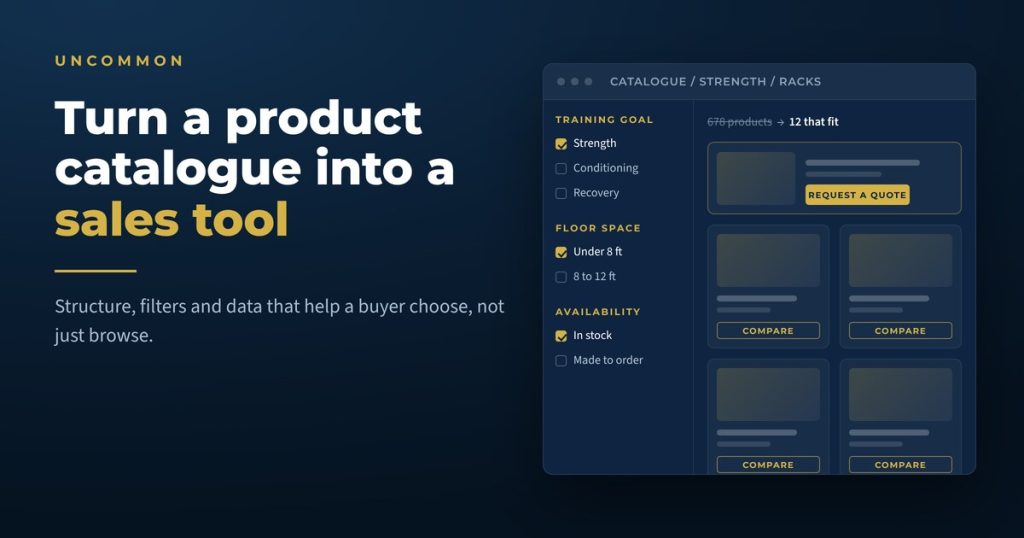
A product catalogue website can hold hundreds or thousands of items and still leave buyers wondering where to begin.
This usually happens when the catalogue was built around internal product data. Categories mirror the company database. Filters use language familiar to the sales team. Product pages display whatever information happened to be available during upload.
Customers arrive with a different point of view. They may know the outcome they need, the equipment they already own or the budget they need to stay within. Some have a model number ready. Others are still trying to understand which type of product solves the problem.
A useful catalogue helps both groups move forward. It connects product data to the way people research, compare and decide while giving every page a job within the larger marketing system. Our guide to building a connected marketing system covers how those pieces support one another; a catalogue is where that system either earns the sale or quietly loses it.
Decide what the catalogue should help people do
Begin with the action a qualified visitor should be able to take.
For a retail business, that action may be adding a product to a cart. A manufacturer might want visitors to request a quote, download technical documentation or find a distributor. Wholesale buyers may need to build an order list before contacting an account representative.
Several actions can exist across the site. Each product type should still have one clear primary path.
This decision affects the entire build. Direct-purchase catalogues need pricing, availability and a streamlined checkout. Quote-driven sites require enough technical detail to qualify interest, along with a form that captures the information sales requires. Businesses using distributors need location and territory logic that reliably sends buyers to the right contact.
Before changing colours or page layouts, document the catalogue’s purpose in a sentence:
The catalogue helps [type of buyer] identify the right [product category] and [take the next step].
That statement gives the design, content and development teams a shared standard for evaluating every decision.
Organize products around how customers search
Internal teams often group products by department, supplier or manufacturing process. Buyers may think in terms of application, compatibility, industry, size or a problem they need to solve.
Research those patterns before designing the main navigation. Useful sources include:
- Website search data
- Sales and customer-service questions
- Search Console queries
- Distributor or dealer feedback
- Competitor terminology
- Interviews with new and experienced customers
The goal is to identify the language buyers use and the details that help them narrow their choices.
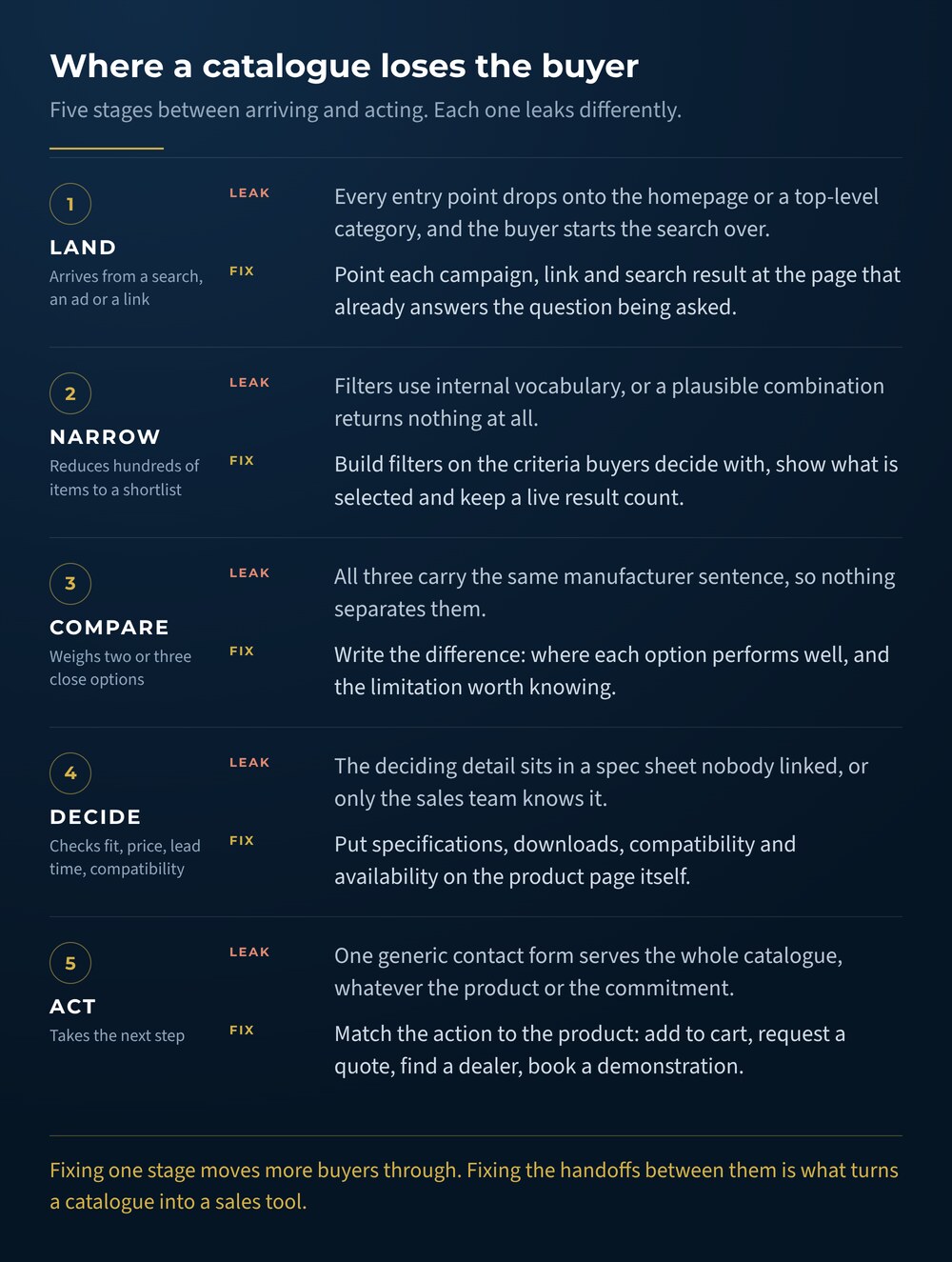
Build a category structure that feels predictable to someone outside the company. Keep top-level choices broad enough to scan, then let subcategories and filters handle specificity. Breadcrumbs can help visitors understand where they are within a large catalogue and move back through the hierarchy. Google also explains how breadcrumb markup can communicate page position in search results.
Test the draft structure with realistic tasks. Ask someone unfamiliar with the database to find a product for a specific use case. Watch where they pause, which terms they misunderstand and whether they choose the route the team expected.
Create a reliable product data model
Large catalogues become difficult to manage when each product record follows a different pattern.
Define the information every product type needs before building templates. Depending on the business, the data model may include:
- Product name and model number
- Category and subcategory
- A short summary written for the buyer
- Key specifications
- Compatible products or systems
- Available sizes, colours or materials
- Product images and diagrams
- Pricing or quote requirements
- Availability and lead time
- Downloads, manuals or safety sheets
- Warranty, shipping or return details
Some fields will apply only to certain categories. Keep shared fields consistent wherever possible so products can be filtered, compared and updated reliably.
Data standards matter just as much as field selection. Decide how measurements are formatted, which abbreviations are acceptable and how product names are written. Establish a source of truth for pricing, inventory and model information. Document who owns each field and how updates reach the website.
This foundational work protects the catalogue from becoming inconsistent again six months after launch.
Make filters reflect meaningful differences
Filters should help buyers reduce a large set of choices using criteria they understand.
For a fitness equipment catalogue, useful filters might include equipment type, training goal, available space, price range or brand. An industrial catalogue may need voltage, material, load rating, dimensions or compatibility.
Every filter should represent a meaningful distinction in the decision. Avoid showing filters that produce empty or nearly identical result sets. Use clear labels, show selected options and make it easy to remove a filter without starting over.
The Baymard Institute’s product-list and filtering research is based on thousands of usability-testing sessions and extensive benchmarking of leading ecommerce sites. Its work shows how much deliberate user-experience planning sits behind product lists that feel simple to use.
Mobile behaviour deserves its own testing. Filters that work comfortably in a desktop sidebar may need a different presentation on a phone. Selected options should remain visible, and the results count should help users understand whether they have narrowed the list too far.
Treat site search as a buying tool
Buyers who know what they want often go directly to the search bar. Catalogue search needs to understand more than exact product names.
Plan for common abbreviations, model numbers, spelling errors and older terminology. Add synonyms when customers use a different phrase than the product database. Search results should reveal enough information to distinguish similar items without forcing visitors to open every page.
Review searches that produce no results. They may reveal missing products, unfamiliar terminology or demand for information your site currently hides. Queries that receive many searches and few clicks can signal weak result labels or poor relevance.
Search data can also guide future SEO and content work. A recurring non-product question may deserve a buying guide, glossary page or comparison article that links back into the appropriate catalogue category.
Build product pages that support a decision
A product page should answer the questions a buyer would ask before taking the next step.
Start with a clear product name and a short explanation of who the item is for or what it helps them accomplish. Follow with scannable specifications, strong images and the information needed to evaluate fit.
The page may also include:
- Use cases or recommended applications
- Compatibility details
- Variant options
- Delivery or installation information
- Related accessories
- Downloads and technical resources
- Frequently asked questions
- Proof from customers or completed projects
Original product photography can make details easier to understand and give the catalogue a more consistent visual language. Uncommon’s photography and visual brand asset service can support product images, demonstrations and branded media for use across the website.
Write descriptions that help a buyer distinguish the product from nearby alternatives. Repeating a manufacturer sentence across dozens of pages gives customers little guidance and creates weak search content. Explain the meaningful differences, the context in which each option performs well and any limitations a buyer should understand.
Offer the right conversion path
Some catalogue visitors are ready to buy. Others need pricing, technical confirmation or help choosing between similar products.
Match the call to action to the product and the level of commitment required. Options may include:
- Add to cart
- Request a quote
- Ask a product specialist
- Find a dealer
- Check availability
- Book a demonstration
- Download the specification sheet
Use one visually dominant action on each template and place supporting actions nearby. Give buyers enough context to understand what happens after they click. Quote forms can mention the expected response time, while dealer finders can explain what information is needed to show local results.
Keep forms focused on the information required for the next conversation. Long forms can be appropriate for complex products when each field has a clear purpose. Conditional questions can reduce clutter by showing detailed fields only when they apply.
Once a form is submitted, marketing automation can route the inquiry, send the relevant resource and alert the correct salesperson. The confirmation page should explain the next step and provide a way to continue researching. If you are sending paid traffic into the catalogue, it is worth reading before you run ads, check the page people will land on first.
Help search engines understand the catalogue
A catalogue contains many pages with related terms, variants and attributes. Clear technical structure helps search engines find and interpret that content.
Google’s ecommerce SEO guidance covers navigation, site structure, URLs and product data. Many recommendations also apply to catalogues where products are researched online and purchased through a dealer or sales representative.
Important foundations include:
- Crawlable links between categories and products
- Descriptive, stable URLs
- Unique page titles and descriptions
- Useful category copy
- Canonical handling for variants and filtered URLs
- XML sitemaps that include active product pages
- Redirect plans for discontinued or renamed products
Structured data can give Google explicit information about a product. The correct implementation depends on whether the page supports a direct purchase, displays a product for research or represents several variants. Google provides separate guidance for product variants and merchant listings.
Pagination and “load more” patterns also need technical planning. Google’s guide to pagination and incremental page loading explains how user-friendly display patterns can affect product discovery by crawlers.
Web development and hosting should bring these search requirements into the build from the beginning. Repairing crawl paths and URL logic after hundreds of pages are live is far more disruptive.
Protect speed and accessibility as the catalogue grows
Product catalogues are vulnerable to slow pages because they rely on images, filters, third-party scripts and large databases.
Compress images appropriately, use responsive image sizes and avoid loading every product asset at once. Test real category and product pages on mobile connections. The web.dev performance guidance explains how Core Web Vitals measure loading speed, responsiveness and visual stability from a user’s perspective.
Accessibility should be built into templates and content workflows. Product images need useful text alternatives when they convey information. The W3C recommends using short alt text that communicates an image’s meaning or function. Form labels, keyboard navigation, colour contrast and visible focus states also need testing throughout search, filtering and conversion flows.
A fast, accessible catalogue gives more buyers a dependable way to use the site. It also reduces the chance that future products inherit problems hidden inside the original template.
Plan how the catalogue will stay accurate
The launch date is the beginning of the catalogue’s operational life.
Create a workflow for new products, revisions and discontinued items. Decide who approves copy, specifications, imagery and pricing. Establish what happens when an item is replaced by a newer model and which historical URLs should remain available for support or search demand.
Where possible, connect the website to the system that already manages product information. An integration can reduce duplicate entry and prevent conflicts between the site, inventory platform and sales materials. Human review remains important for customer-facing descriptions, categorization and merchandising decisions.
Schedule regular catalogue audits. Look for missing images, empty fields, broken downloads, outdated calls to action and products that have become difficult to reach through navigation. Analytics and internal search data can show where visitors struggle or abandon the process.
Measure whether the catalogue supports sales
Page views show activity. Sales-focused measurement reveals whether visitors are moving toward a useful outcome.
Track the actions that match the catalogue’s purpose, such as:
- Product-to-quote conversion rate
- Add-to-cart and completed-purchase rate
- Dealer-finder usage
- Specification or catalogue downloads
- Product comparison activity
- Contact requests by category
- Internal searches with no results
- Revenue or qualified opportunities influenced by catalogue pages
Review performance by category and traffic source. Highly technical products may attract fewer visitors while generating more valuable inquiries. Popular categories with weak conversion may need clearer selection guidance or a stronger next step.
Connect website data to the CRM when the sales process continues offline. This helps the team see which categories generate qualified opportunities and which resources appear in successful buying journeys. It is the same principle behind a website that does more than exist politely online: the site has a job, and the job is measurable.
What this looked like for Beyond the Basics Fitness
Beyond the Basics Fitness needed to rebuild a catalogue containing 678 products. At that scale, the website had to do more than display inventory. Buyers needed a clear way to move through the range and find the information relevant to their decision.
The rebuild treated structure as the product. Behind those 678 items sat 1,779 product images, 52 manufacturer brands, 42 categories and 181 tags, all of which had to be reconciled into one predictable taxonomy before a single template was designed. Because commercial fitness equipment is quote-driven rather than cart-driven, the primary action on a product page is a quote request, and buyers can gather several items into a shared wishlist before they contact the team. Legacy URLs were mapped through 1,447 redirects so the search visibility the old catalogue had earned survived the move.
The project is a useful example of treating catalogue structure as part of the sales experience. Product organization, page templates and conversion paths need to work together when hundreds of individual records are involved.
Explore the Beyond the Basics Fitness case study to see how Uncommon approached rebuilding a large catalogue as a practical sales tool.
Product catalogue website checklist
Use this checklist before a catalogue rebuild or major update:
- Define the primary action for each product type.
- Map how customers describe products and narrow their options.
- Create a consistent data model for every category.
- Standardize names, measurements and product attributes.
- Design filters around meaningful buying criteria.
- Improve search with synonyms, model numbers and common misspellings.
- Write descriptions that explain differences between similar products.
- Add useful images, specifications and downloads.
- Match calls to action to the buyer’s next step.
- Build crawlable categories, stable URLs and sensible variant handling.
- Test page speed, mobile usability and accessibility.
- Connect form submissions to a reliable follow-up process.
- Assign ownership for ongoing product updates.
- Measure qualified actions by product category.
The best place to begin is the part of the catalogue that creates the most friction for customers or the most value for the business. Improving one high-priority category can reveal the data, content and development standards needed for the rest of the site.
Build a catalogue that helps customers choose
A large product range becomes easier to sell when the website helps buyers understand it. Clear structure, reliable data and useful decision support can turn a crowded catalogue into one of the strongest tools available to sales and marketing.
Uncommon combines web development, SEO and automation to build catalogue experiences around how customers actually buy. Contact the Uncommon team to talk about rebuilding or improving your product catalogue website.