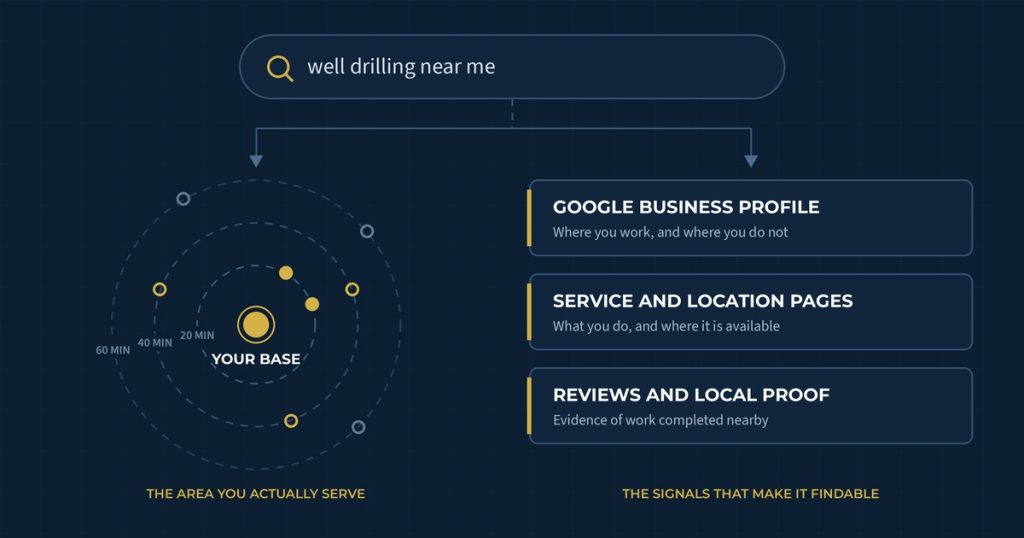
Your business may be based in one town while your customers live across an entire region.
That is normal for contractors, home-service companies, mobile providers and many professional services. It also creates a common search problem: how do you help someone twenty or forty minutes away find your business when they search for the service they need?
Effective local SEO for service-area businesses makes your coverage clear to customers and search engines. It combines an accurate Google Business Profile, useful service and location pages, local proof, strong website structure and a steady reputation-building process.
The result is a more credible online presence across the communities you genuinely serve.
What is a service-area business?
Google defines a service-area business as one that visits or delivers directly to customers without serving them at its business address. Plumbers, cleaners, landscapers and mobile service providers are common examples.
A hybrid business serves customers at its physical location and also travels or delivers to them.
This distinction matters when setting up your Google Business Profile. According to Google’s service-area business guidance:
- A business that does not receive customers at its address should remove that address from public view.
- One service-area profile can include up to twenty cities, postal codes or other defined areas.
- The overall coverage should generally remain within about two hours of the business location.
A service-area business typically uses one profile for the area it serves. Businesses with independently staffed locations may qualify for separate profiles, and each location must meet Google’s eligibility and representation guidelines.
Accurate setup gives customers a realistic picture of where the company works. It also protects the profile from avoidable suspensions caused by virtual offices, mailboxes or addresses that do not meet Google’s rules.
Why service-area local SEO is more complicated
A storefront has a clear geographic anchor. Customers visit a specific address, and Google can use that location when evaluating nearby searches.
A service-area business travels outward from its base. The company may be highly relevant to a customer in another community while still facing a distance disadvantage in local map results.
Google says local rankings are mainly influenced by relevance, distance and prominence. Its local-ranking guidance explains that these factors help Google determine which businesses are the best match for a local search.
Selecting a city as a service area communicates where you operate. The wider local SEO strategy still needs to establish:
- Which services you provide
- Where those services are genuinely available
- Whether your business appears established and trustworthy
- How your website supports the customer’s search
- Whether nearby customers choose and recommend you
This is why changing a profile setting rarely solves the whole problem. Visibility grows through a collection of clear, consistent signals, in the same way a connected local marketing system moves someone from discovery to a booking.
Start with an accurate Google Business Profile
Your Google Business Profile should describe the business as it operates in real life.
Review the following details:
Business category
Choose the most specific primary category that accurately reflects the company’s main service. Additional categories can cover meaningful secondary services.
Service areas
List the communities, postal codes or regions you regularly serve. Keep the coverage realistic for your team, travel time and business model.
Address visibility
Hide the address when customers are not served there. A home office, equipment yard or administrative address does not become a storefront unless customers can visit during stated hours and the location meets Google’s requirements.
Services
Add the services customers can actually book or request. Use the same language people will find on the corresponding website pages.
Hours and contact information
Keep phone numbers, business hours and holiday availability current. The information should match the website and other major business listings.
Photos and updates
Use real images of completed work, equipment, employees and service situations. These details help customers recognize the business and understand what to expect.
A well-maintained profile gives your local SEO and content system a reliable foundation.
Build website pages around services people search for
Many service-area websites try to cover everything on one homepage. That limits how clearly the site can answer specific searches.
Someone looking for emergency pump service has different questions from someone researching a new well. A commercial buyer may need different proof than a homeowner. Dedicated service pages create room to address those needs properly.
A strong service page should explain:
- What the service includes
- Who commonly needs it
- Which problems or goals it addresses
- Where it is available
- What the process looks like
- Relevant licences, qualifications or experience
- The clearest next step
Connect those pages through descriptive internal links. Google’s link guidance recommends concise anchor text that helps people and search engines understand the destination.
For example, “learn about our well inspection services” gives more context than a generic “click here.”
Thoughtful web design and development makes this content easy to navigate on both desktop and mobile devices. Clear page titles, headings and URLs help search engines interpret the structure too.
Create location pages only when they provide local value
Location pages can support search visibility when each page helps customers in that community.
A useful page might include:
- Services available in that location
- Travel, access or scheduling details that affect the work
- Local regulations, permits or environmental considerations
- Projects completed nearby
- Testimonials from customers in the area
- Photos tied to local work
- Answers to questions commonly asked by residents there
- A clear explanation of how to request service
The page should give a local customer information they would struggle to get from a generic service description.
Problems arise when a business publishes dozens of nearly identical pages and swaps only the city name. Google classifies pages created for similar searches that funnel visitors toward the same destination as potential doorway abuse. Its spam policies specifically identify substantially similar regional or city pages as a concern when they add little value.
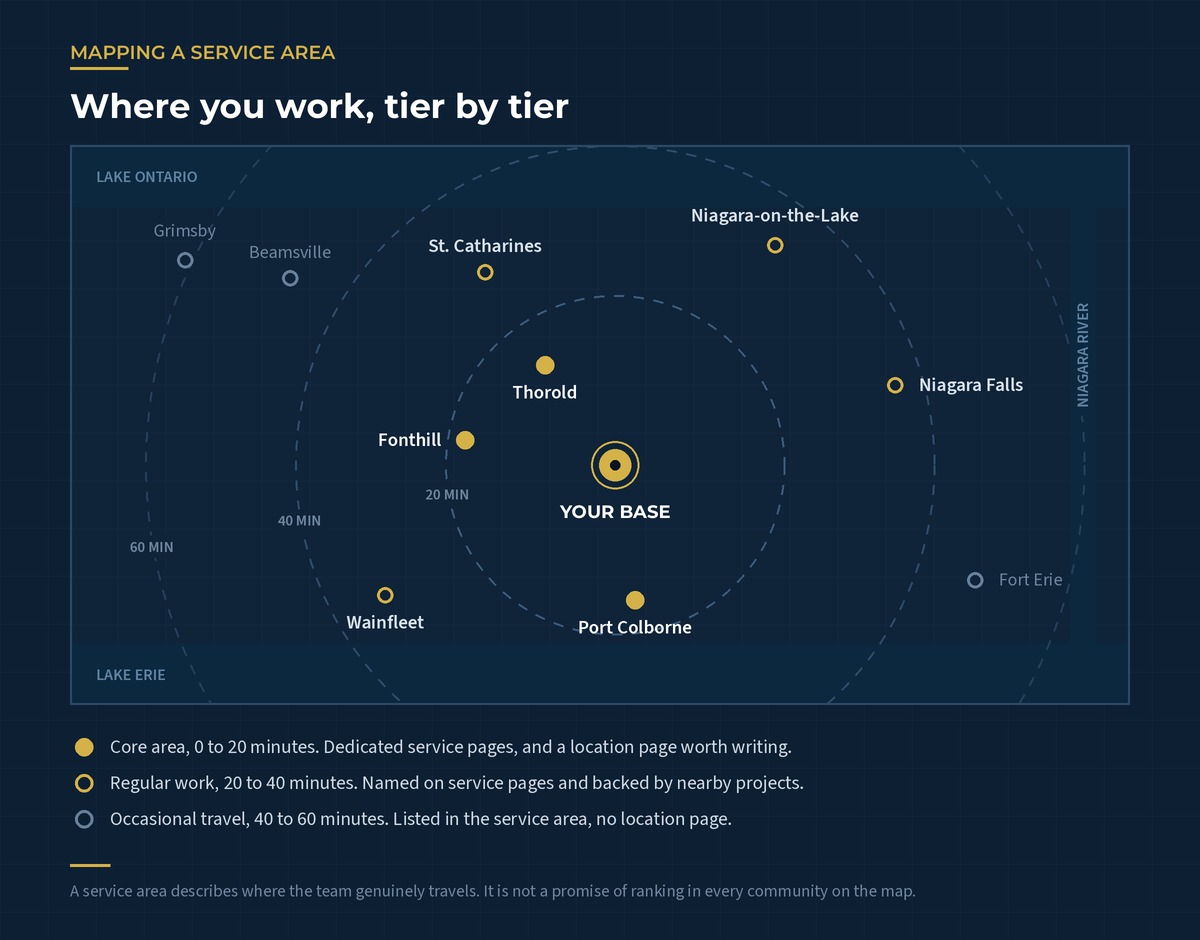
Choose locations strategically. A smaller group of genuinely useful pages can build stronger trust and create a better website experience.
Add proof from the communities you serve
Local proof turns a service-area claim into something customers can evaluate.
Instead of listing twenty place names in a footer, show evidence of real work across the region. That proof might include:
- A case study from a nearby project
- Before-and-after photos with location context
- Customer reviews that naturally mention the community or service
- Partnerships with regional organizations
- Membership in local trade associations
- Team knowledge of the area’s common challenges
Use specific details while protecting customer privacy. A project can often be described by community, property type and service without sharing a precise residential address.
This material can support several parts of the marketing system. A completed project may become a website example, a Google Business Profile update and a social post. Regional questions can shape future blog articles and FAQs.
The strongest proof reflects work the business has genuinely completed.
Build a steady review process
Reviews contribute to the trust surrounding a service-area business. They also help prospective customers understand whether the company has experience with the service they need.
Google recommends responding to reviews and keeping Business Profile information current as part of its local visibility guidance. It also allows businesses to create a direct review link or QR code to simplify the request process.
A practical workflow could look like this:
- Confirm that the customer’s service has been completed.
- Send a brief, direct request from the person or team they worked with.
- Provide the correct Google review link.
- Respond after the review is published.
- Record recurring customer language and questions for future content.
Encourage customers to describe their experience in their own words. Specific reviews are more useful to readers and create a more credible picture of the business.
Keep your business information consistent
Search engines and customers encounter your business in many places: the website, Google Business Profile, industry directories, association listings and social profiles.
Core details should remain consistent across those sources:
- Business name
- Phone number
- Website address
- Hours
- Services
- Public address or service-area information
Old phone numbers and duplicate listings create confusion. Schedule a recurring audit of the directories that matter most to your industry and region.
The website can also use LocalBusiness structured data to give search engines explicit information about the organization. The markup must accurately reflect content that visitors can see on the page.
Publish content that answers regional service questions
Service pages explain what you sell. Educational content can answer the questions customers ask before they are ready to call.
Useful topics for a service-area company may include:
- How local soil, weather or property conditions affect the service
- What permits or inspections may be required
- Warning signs that indicate a problem
- How to compare repair and replacement options
- Seasonal maintenance guidance
- Questions to ask before hiring a provider
- What affects pricing or project timelines
These articles should connect naturally to the appropriate service and location pages. The topic becomes part of a broader content cluster instead of an isolated blog post.
A strategic content system also gives sales and service teams a helpful resource to send when customers ask familiar questions.
Use paid search to support priority areas
Organic local visibility develops over time and will vary by location. Paid search can support priority services, seasonal demand or communities where the business wants more immediate reach.
Each campaign should lead to a relevant page with clear service information and an easy conversion action. Calls and form submissions need tracking so the business can compare lead quality across services and locations.
Paid advertising works best when it shares the same message, proof and geographic priorities as the website and local SEO strategy.
What this looked like for Field Well Drilling
Field Well Drilling brought more than a century of real-world credibility to the project. The company’s own history traces its roots to 1896 and describes four generations of drilling expertise in Southern Ontario.
That reputation deserved an online presence that made the company easier to find when people across Niagara searched for relevant services.
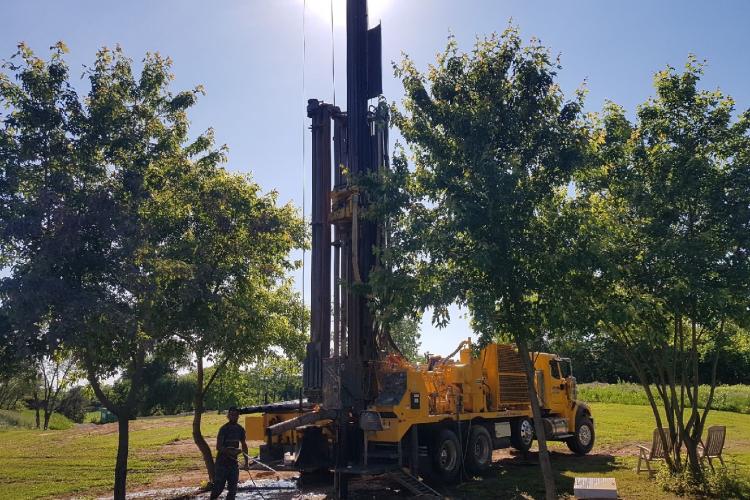
Uncommon’s work focused on local SEO and content systems, translating established regional expertise into clearer search visibility. The result was improved rankings and a stronger connection between the services people needed and the business qualified to provide them.
The project offers an important lesson for service-area businesses: longevity and local reputation become more powerful online when the website clearly communicates what the company does, where it works and why customers trust it.
Explore the full Field Well Drilling case study.
A local SEO checklist for service-area businesses
Use this list to find the clearest opportunities:
- Confirm whether the company is correctly classified as a service-area or hybrid business.
- Remove any public address where customers are not served.
- Choose accurate categories, services and operating hours.
- Set realistic service areas based on actual operations.
- Create a dedicated page for each major service.
- Publish location pages only where unique local information is available.
- Add project examples and regional proof throughout the site.
- Establish a consistent review-request process.
- Correct outdated business information across important directories.
- Connect educational content to service and location pages.
- Track calls, forms and qualified leads by service and region.
Start with the service and community that matter most to the business right now. Build one strong path from search to inquiry, measure what happens and use those lessons to expand the system thoughtfully. If you are working through this in Niagara, our guide to what local SEO actually means for a Niagara business covers the groundwork.
Help more local customers find the right service
Strong service-area SEO gives customers a clearer route to your business. Accurate profile information supports discovery. Service and location pages explain your relevance. Reviews and project examples add the proof people need before they call.
Uncommon helps regional businesses connect those pieces through marketing strategy, SEO, content and website development. Tell us which services and communities you want to grow, and we’ll help you build the clearest path forward.