A local business can have a good website, a handful of five-star reviews, an active Instagram account and a Google Ads campaign, and still struggle to turn attention into bookings.
Each channel may be doing its job. The gap usually appears between them.
Someone sees a post and searches for the business, but the Google listing is incomplete. Another person clicks an ad and lands on a homepage that barely mentions the offer. A happy customer plans to leave a review, then gets busy because the process requires too many steps.
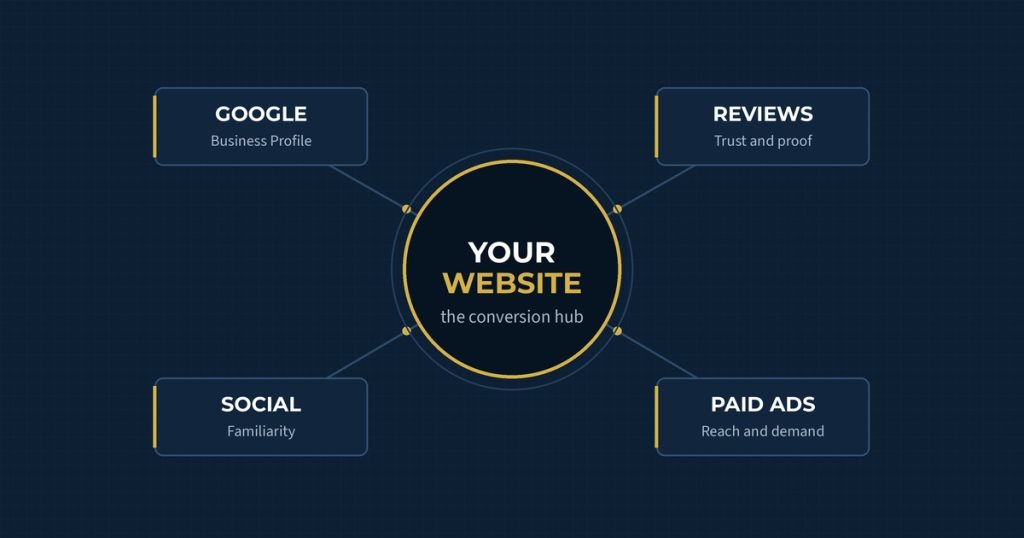
A strong local marketing strategy for a small business connects those moments. The website answers the question raised by the ad. Reviews confirm the promise. Social content helps people picture the experience. The booking process lets them act while their interest is high.
That is a connected local marketing system.
What is a connected local marketing system?
A connected local marketing system aligns the places where someone discovers, evaluates and contacts your business.
Every part has a clear job:
- Google Search and your Business Profile help nearby customers find you.
- Reviews and social content build recognition and trust.
- Your website and landing pages explain the offer clearly.
- Booking forms, calls and follow-up turn interest into action.
The system should feel simple from the customer’s side. They see something relevant, confirm that the business looks credible and quickly find the next step.
Behind the scenes, that simplicity requires coordination.
Disconnected marketing creates small leaks
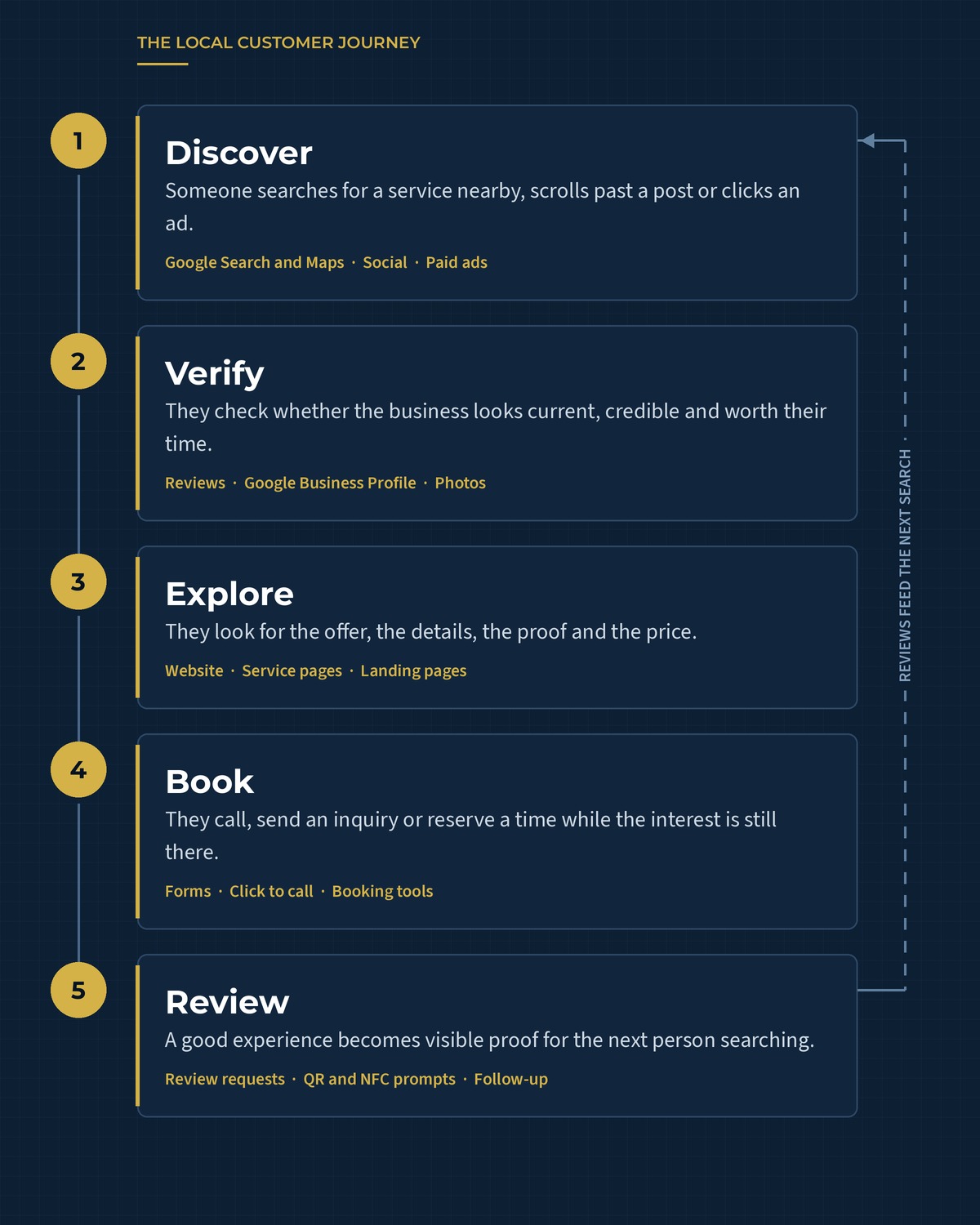
Most local customer journeys involve more than one touchpoint.
A parent might see a birthday-party video on Instagram, search the business name on Google, read recent reviews, visit the website and check the booking details before making an inquiry. A homeowner may start with a service search, compare several websites, return to Google Maps and call the company with the clearest information.
Every transition creates an opportunity to keep their confidence, or to lose it.
Common leaks include:
- Social profiles promoting offers that are difficult to find on the website
- Google Business Profile information that conflicts with current hours or services
- Ads sending every visitor to the homepage
- Contact forms that ask for unnecessary information
- Great customer experiences with no reliable review-request process
- Campaigns measured by clicks and views without tracking calls, inquiries or bookings
A marketing strategy should show how these pieces support the same business goal. Otherwise, each platform becomes another item to maintain.
Your website is the conversion hub
Your website is where curiosity becomes a decision.
Someone arriving from Google Search may need proof that you serve their area. A social media visitor may want pricing or event details. Paid traffic expects to see the exact offer promised in the ad. The website has to support all of those entry points without making people hunt.
For a local business, the essentials include:
- A clear description of what you offer and who it is for
- Accurate location, hours and contact information
- Dedicated pages for important services or experiences
- Real photos that help visitors understand what to expect
- Reviews or other relevant trust signals
- A visible call, inquiry, booking or purchase option
- A mobile experience that is quick and easy to use
Mobile performance matters because Google uses the mobile version of a site for indexing and ranking. Its mobile-first indexing guidance recommends keeping important content and metadata consistent across mobile and desktop versions.
Good web design and development creates a useful path through the site. Clear brand messaging gives visitors enough information to choose the next step with confidence.
Google helps local customers find and evaluate you
For many local businesses, Google Search and Google Maps act like a second front door.
Google explains that local results are primarily influenced by relevance, distance and prominence. Complete business information, current hours, photos and responses to reviews can all help customers understand the business they have found. You can read Google’s full local-ranking guidance here.
Your Google Business Profile should match your website on the details that matter:
- Business name
- Address or service area
- Phone number
- Operating hours
- Services and categories
- Booking or appointment links
That consistency makes the experience clearer for customers and gives search engines better information to work with. Adding accurate LocalBusiness structured data to the website can provide Google with additional details such as hours, departments and business information.
This is also where SEO and content support the rest of the system. Service pages help search engines understand what you do. Useful local content answers the questions people ask before they contact you.
Reviews turn customer experiences into visible proof
Reviews often bridge the space between “this looks interesting” and “I trust this enough to book.”
According to BrightLocal’s 2026 Local Consumer Review Survey, 31% of surveyed consumers said they would only use a business with a rating of at least 4.5 stars. Recent, specific feedback gives prospective customers context that a star rating alone cannot provide.
A useful review system makes asking part of the customer experience. Staff should know when to ask, and customers should receive a direct path to the correct profile. Google allows businesses to create a review link or QR code that can be shared through email, receipts or in-person signage.
Keep the process ethical and straightforward:
- Invite genuine customers to share their experience
- Avoid incentives tied to positive ratings
- Respond professionally to both praise and criticism
- Look for recurring themes that could improve the business
- Keep review requests consistent enough to generate fresh feedback
Reviews can strengthen other channels too. With permission and the right context, customer language can influence website copy, FAQs and social content. The feedback becomes useful insight instead of sitting on one platform.
Social media creates familiarity before someone is ready to buy
Local social media gives people a feel for the business that static service descriptions cannot always capture.
A polished website may explain that a venue hosts parties. A short video can show the room, the energy and what guests actually do there. A service business can publish a recent project, answer a common question or introduce the person who will arrive at the customer’s home.
That familiarity can make the next search feel less like a cold comparison.
An effective social media strategy usually includes a practical mix of:
- Experiences and offers people can book
- Real customer questions
- Behind-the-scenes details
- Seasonal or location-specific information
- Proof of completed work or happy customers
- Community connections and timely updates
Every post does not need a hard sell. The profile as a whole should help someone understand what the business offers and where to go next.
Links, profile buttons and campaign calls to action should lead to the most relevant website page. A birthday-party post belongs with birthday-party information. A league announcement should connect to current league details. Fewer steps make it easier for interest to become action.
Paid ads work harder when the path already makes sense
Advertising can introduce a local offer to more people or capture demand from someone actively searching. Its performance depends heavily on what happens after the click.
Google includes usefulness, relevance, navigation and alignment with the visitor’s expectations in its explanation of landing-page experience. An ad for a specific service should lead to a page built around that service.
A focused landing page can include:
- The exact offer featured in the ad
- Who it is for
- Pricing or enough information to understand the commitment
- Relevant photos, reviews or examples
- Answers to likely objections
- One obvious conversion action
Sending every campaign to the homepage asks the visitor to finish the strategy themselves. A dedicated page continues the conversation they already started.
Strong paid advertising can then amplify an offer with a clear message and a working conversion path. Tracking should follow the journey through to calls, forms, bookings or purchases so the business can see which campaigns create meaningful results.
What this looked like for Digital Golf Fort Erie
Digital Golf Fort Erie had an experience people could enjoy year-round. The marketing opportunity involved making the business easier to find, easier to trust and easier to book.
Our work connected several parts of the customer journey:
- The website experience was refreshed and supported by an online inquiry form.
- Social content increased local visibility, with a top post reaching more than 13,000 views.
- A Google review strategy helped the business grow from zero reviews to 17 while maintaining a 5.0 rating at the time the results were documented.
- An in-store NFC review tag reduced the effort required for happy customers to leave feedback.
- A birthday-party landing page gave families the details they needed in one place.
- Google Ads directed relevant traffic toward that specific party offer.
- Website and social updates kept league information current across the customer journey.
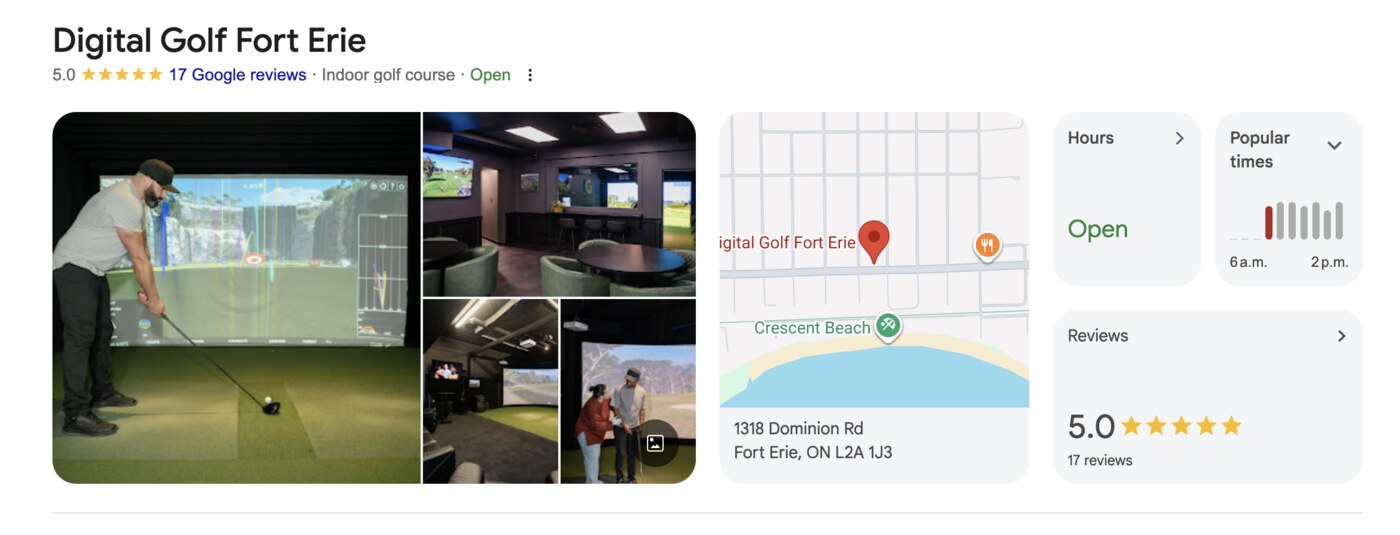
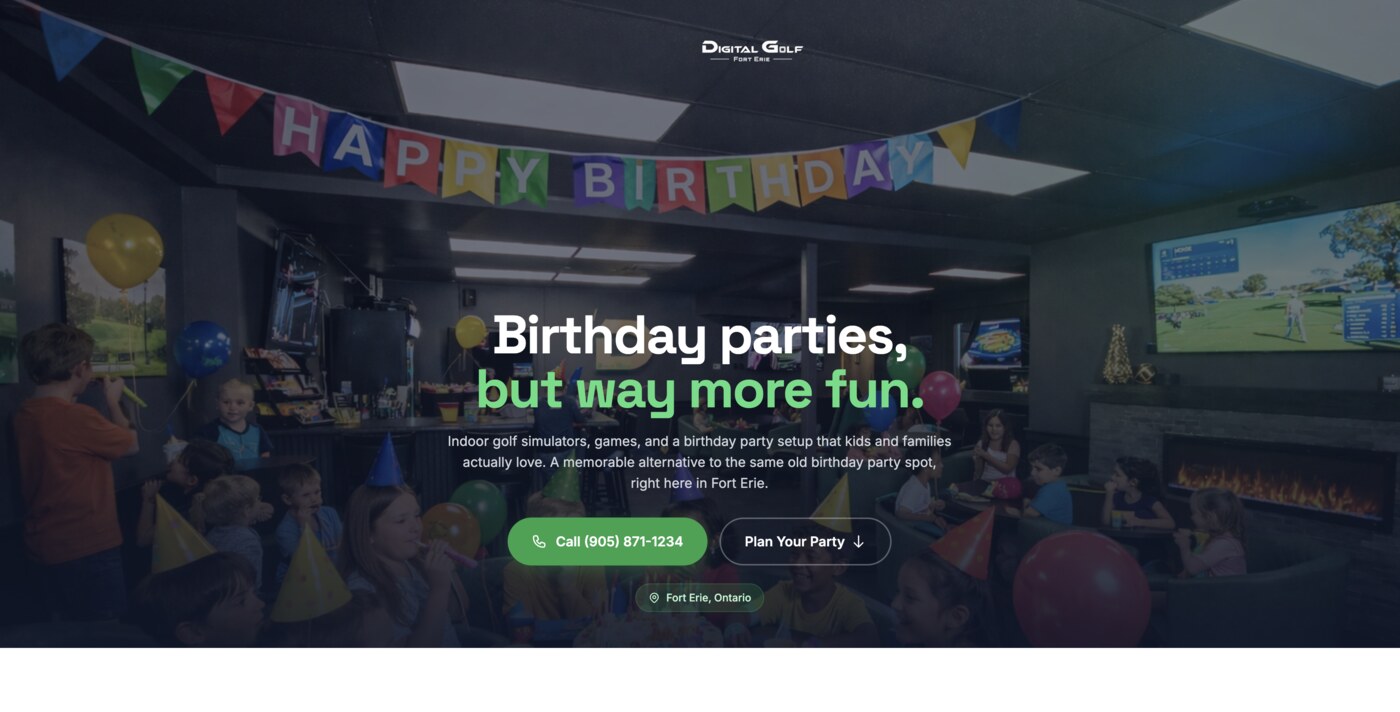
The value came from the way those pieces reinforced one another. Social content generated attention. Reviews added credibility. The website clarified the experience. Focused campaign pages created a direct path toward an inquiry.
You can see more of the work in the Digital Golf Fort Erie case study.
Where should your local business start?
Begin with the point where interested customers are currently getting stuck.
| What you are seeing | Likely area to investigate |
|---|---|
| People do not find the business in local searches | Google Business Profile, local SEO and service pages |
| Prospects find you but hesitate to contact you | Reviews, proof, messaging and photos |
| Website traffic produces few inquiries | Page clarity, calls to action and mobile usability |
| Ads generate clicks without conversions | Offer alignment and landing-page experience |
| Customers have a good experience but rarely leave reviews | Timing and ease of the review-request process |
Choose one primary business goal, such as birthday-party inquiries, consultation bookings or quote requests. Then map the shortest useful path from discovery to action.
Ask:
- Where is the right customer most likely to discover this offer?
- What will they need to believe before they contact us?
- Which page answers their most important questions?
- How can they take the next step with minimal friction?
- What will we track to know whether the system is working?
This creates a focused starting point. Once that path works, the same thinking can support the next offer or audience.
Build a local marketing system that works together
Local marketing becomes more useful when every channel supports a shared customer journey.
Your Google presence helps the business get discovered. Reviews and social content build confidence. The website turns that attention into understanding. Landing pages, forms and booking tools create a clear next step.
Uncommon helps businesses connect those pieces through strategy, websites, content, local visibility and paid campaigns. Tell us where your marketing feels stuck, and we will help you find the part of the system that needs attention first.