Most B2B companies are sitting on more content than they realize.
It lives in sales calls, project debriefs, support emails and the explanations your team gives so often that they barely notice the value anymore. Inside the company, people understand why buyers hesitate and which expensive mistakes appear six months into a project. They can also explain an industry change in plain language.
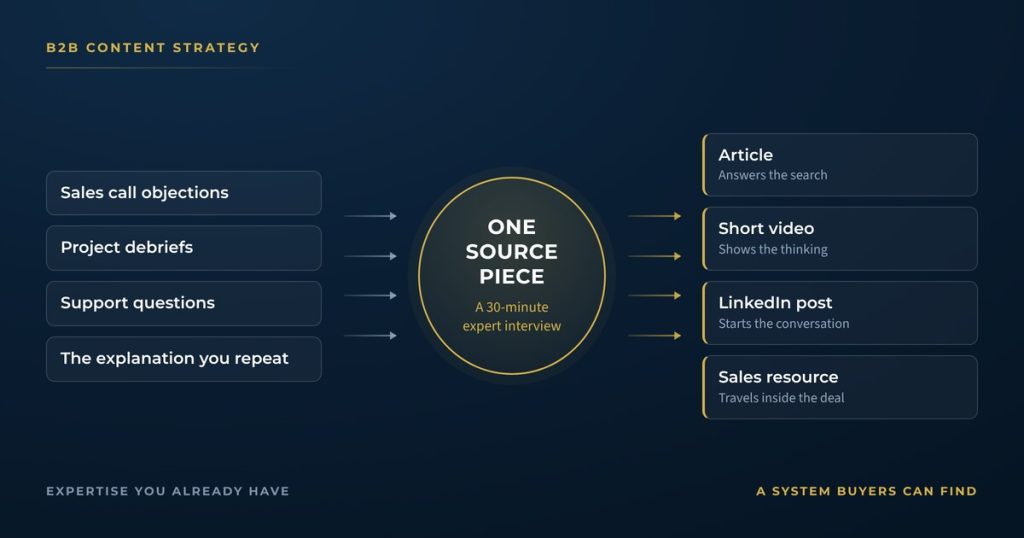
That knowledge can become a useful B2B content strategy. The challenge is getting it out of people’s heads and into a system your audience can find, understand and remember.
A dependable system also gives each piece of content somewhere to go. Video can support a service page, while a customer question can become a search-friendly article. Strong opinions can start useful LinkedIn conversations and later shape sales resources.
This is where B2B content starts contributing to the larger marketing picture. Our guide to building a connected marketing system explains how your website, search presence, reviews, social media and advertising can support one another. Content supplies the ideas and proof that move through that system.
Why B2B content has influence before the sales call
B2B buying decisions often involve people who never appear on your lead form. A department head may love the solution while finance, procurement, IT or compliance quietly shapes the final decision.
The 2025 Edelman and LinkedIn B2B Thought Leadership Impact Report calls these stakeholders “hidden buyers.” The report draws on responses from nearly 2,000 professionals and explains how useful thought leadership can reach people who have limited contact with sales teams.
That matters because a sales presentation cannot carry the whole job of building confidence. Buyers may encounter your company through a colleague’s post, a Google search or an article shared inside their team. Each encounter helps them decide whether your business understands their situation.
Strong content gives those buyers something useful to pass along. It can explain the cost of the problem, provide language for an internal discussion or help a stakeholder evaluate possible approaches. By the time someone books a call, several people may already have formed an opinion about your expertise.
Smaller B2B companies have a genuine opening here. Edelman’s analysis found that 53% of B2B decision-makers say brand recognition matters less when a company’s thought leadership is strong. Helpful ideas can earn attention even when a better-known competitor has a larger budget.
Begin with the business outcome
A content calendar is easier to fill when the team knows what the content needs to accomplish.
Choose one primary business outcome for the next quarter. You may want to become known in a specific industry, support a service with a long sales cycle, enter a new market or generate better-qualified conversations.
The outcome should be specific enough to guide topic decisions. For example, “help Ontario manufacturers understand when their legacy training process has become a growth constraint” gives the team more editorial guidance than a broad activity goal such as “post more on LinkedIn.”
This decision also helps you avoid a familiar B2B content trap: publishing a wide assortment of company updates that have little connection to what prospective customers need. Team milestones and event photos can still have a place. They work best alongside content that teaches, interprets and demonstrates how your company thinks.
If your business needs help defining that larger direction, marketing strategy and management can connect content decisions to revenue goals, customer priorities and the rest of your marketing plan.
Map the people involved in the decision
A useful B2B content strategy accounts for more than the person who will use the product or service every day.
Start by mapping the roles that influence a typical decision. For each role, document:
- What they are responsible for protecting or improving
- Which risks are most likely to concern them
- What evidence they need before supporting a purchase
- Which questions they may ask when your contact presents the idea internally
An operations lead may care about implementation time. Finance may want to understand total cost and expected return. An executive sponsor may need confidence that the project supports a larger priority. Your content does not need to address every stakeholder in every piece. Across the system, it should help the buying group reach a shared understanding.
This exercise usually reveals valuable content topics. Technical FAQs may help evaluators, while cost-of-delay articles can support budget discussions. Implementation guides can reduce anxiety for the team responsible for rollout.
Build topics from real conversations
Keyword research has an important place in a B2B SEO and content system. Your team’s everyday conversations add context that keyword tools cannot fully capture.
Collect questions from sales, customer success, project delivery and leadership. Look for phrases such as:
- “Customers are always surprised when…”
- “The main reason projects get delayed is…”
- “People usually compare us with…”
- “We wish prospects understood this before calling…”
Turn those observations into a working question bank. Then review search data to see how buyers express related needs online. The strongest topics often sit where customer language, business expertise and relevant search demand overlap.
Google recommends creating helpful, people-first content that demonstrates first-hand expertise and leaves readers with enough information to move toward their goal. A subject-matter expert’s direct experience can provide the examples, nuance and practical guidance that make an article genuinely useful.
Choose a small set of durable themes
Content pillars give your team repeatable territory without forcing every post into the same format.
A B2B software company might focus on adoption, operational efficiency, data governance and industry change. Professional services firms may build themes around common risks, decision-making, implementation and measurable outcomes.
Each theme should meet two tests:
- Your audience regularly needs help with it.
- Your company has credible experience worth sharing.
Four or five durable themes are usually enough to create range while keeping the brand recognizable. They can support articles, videos, newsletters, webinars and social posts over time.
Once the themes are set, create a simple idea bank beneath each one. Add questions, stories, client examples, data points and opinions as they surface. This gives the team a shared place to capture useful material before it disappears into another meeting.
Create one strong source piece, then adapt it thoughtfully
Content repurposing works best when the source material has depth.
A monthly interview with a subject-matter expert can produce enough material for a substantial article, a short video series, several social posts and a sales follow-up resource. Recorded webinars can lead to an FAQ page and a set of clips organized around individual questions.
Each version should suit the place where it appears. A LinkedIn post may lead with a sharp observation from the interview. The article can explain the full idea and target a relevant search query. A sales email can point a prospect to the section that addresses their concern.
Content production can help turn internal knowledge into polished video and audio assets. Social media management gives those assets a consistent publishing rhythm and creates space for conversation around them.
The source-piece approach reduces the pressure to invent unrelated ideas every day. It also lets the audience encounter the same useful perspective in several formats without receiving identical copy on every channel.
Give every channel a clear role
B2B teams often spread content across several platforms without deciding what each one contributes.
Your website should hold durable resources: service pages, case studies, articles and tools that buyers can revisit or share. Search helps people discover those resources when they are actively investigating a problem. Social channels distribute ideas, introduce the people behind the expertise and reveal which topics create a response.
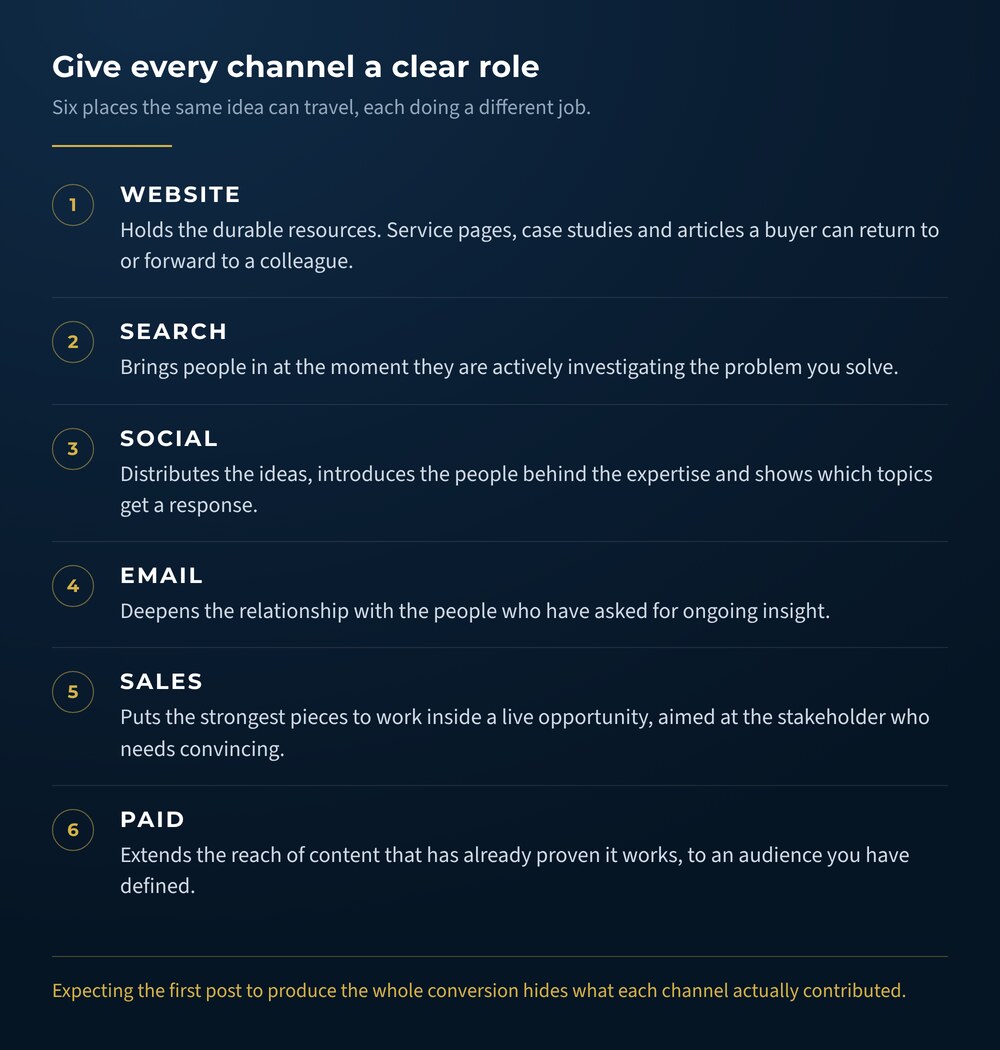
Email can deepen the relationship with people who want ongoing insight. Sales teams can use the strongest pieces during active conversations. Paid distribution can extend the reach of proven content to a defined audience.
This structure also makes measurement more useful. A social post may create awareness while the linked article answers a detailed question. The service page then helps the reader understand the offer and choose a next step. Expecting the first post to produce the entire conversion hides the contribution each channel makes.
Create an editorial workflow people will use
The content system needs to fit the people responsible for keeping it alive.
Assign a clear owner for each stage: idea selection, expert input, drafting, review, design, publishing and distribution. One person may handle several stages. The important part is knowing where a piece stands and who moves it forward.
Set response windows for reviews. A subject-matter expert who receives a focused draft with two questions is more likely to respond than someone asked to “take a look whenever you can.” Keep approval criteria simple enough that every reviewer understands what they are checking.
One workable monthly rhythm could include:
- A 30-minute expert interview
- One substantial source piece
- Four to eight adapted social posts
- An email built around the month’s strongest idea
- A short review of performance and audience questions
Your cadence may be lighter or more ambitious. Consistency comes from matching the plan to available time, then protecting that time on the calendar.
Marketing automation can support distribution and follow-up once the editorial process is stable. Automation is especially useful for routing form submissions, delivering resources and nurturing contacts who are interested but still early in their decision.
Keep expert-led content clear and specific
Expertise can become hard to see when content is packed with abstract language.
Replace broad claims with observations that a buyer can use. “We provide innovative solutions” says little. A detailed explanation of the early warning signs that a system will fail at scale gives the reader something concrete to consider.
Examples build credibility because they show how the idea behaves in the real world. Walk through a decision, explain a trade-off or describe what changed after a team tried a different approach. Protect confidential information while preserving enough detail to make the lesson meaningful.
Research can strengthen the argument, particularly when you link to the original source. The 2025 LinkedIn B2B Marketing Benchmark found that 94% of surveyed B2B marketers viewed trust as essential to success. That trust grows when a company’s content is accurate, useful and recognizably connected to real experience.
Connect attention to a sensible next step
Thought leadership can create interest without turning every paragraph into a pitch.
Make the next step easy to find when a reader is ready. Link an article to the most relevant service page. Add a related case study when the reader may want proof. Offer a consultation, guide or assessment that fits the topic.
The path should make sense from the reader’s perspective. Someone reading an introductory article may want another practical resource. Visitors comparing approaches may be ready for a case study, while people reviewing implementation details may want a conversation with your team.
Use descriptive link text so readers understand where a link will take them. It improves usability and helps search engines interpret the relationship between pages.
Measure whether the system is building useful momentum
Reach and engagement can show which ideas attract attention. B2B content also needs measures that reflect how people research and buy.
Track indicators such as:
- Visits to service and case-study pages from content
- Qualified inquiries that mention an article, video or speaker
- Email subscriptions from high-intent resources
- Content used by sales during active opportunities
- Repeat visits from target companies or industries
- Invitations to speak, collaborate or contribute
Review performance by theme and format over a meaningful period. A technical article may attract modest traffic while becoming a valuable sales asset; short videos may create broader awareness and reveal topics worth developing in depth.
Keep a record of questions that appear in comments, calls and emails after publication. Those questions are evidence of interest and fuel for the next round of content.
What this looked like for XpertVR
XpertVR develops virtual reality training simulations for universities and organizations. The company had a knowledgeable co-founder, a highly visual product and plenty of valuable material. Their content activity was spread unevenly across channels, which made it difficult to build a recognizable presence.
Uncommon helped create a repeatable content framework. The work included establishing a publishing cadence, auditing earlier videos and articles into a searchable content library, relaunching the newsletter, expanding short-form video and improving profile language and cross-links.
That framework helped XpertVR add more than 1,000 relevant LinkedIn followers for its co-founder within a few months. It also supported partnerships with Conestoga College and Brock University, speaking invitations and greater internal participation in content creation.
The value came from organizing the expertise the company already had and making it easier to publish consistently. Explore the complete XpertVR content strategy case study to see how the framework supported authority and new opportunities.
A practical B2B content strategy checklist
Use this list to review your current system:
- Define one business outcome for the next quarter.
- Map the people who influence a typical buying decision.
- Collect recurring questions from customer-facing teams.
- Choose four or five themes tied to audience needs and company expertise.
- Schedule a repeatable way to capture subject-matter expertise.
- Build substantial source material before creating adaptations.
- Assign a clear role to each channel.
- Connect content to relevant service pages and case studies.
- Document owners, review steps and publishing dates.
- Measure business signals alongside reach and engagement.
- Feed new questions and insights back into the idea bank.
You do not need a publishing machine that runs at full speed on day one. Start with a rhythm the team can maintain. Improve it as you learn which topics help buyers, which formats fit your experts and which pathways lead to meaningful conversations.
Turn your expertise into a content system
Your team already knows things your buyers would find valuable. A B2B content strategy gives that knowledge structure, strengthens its reach and connects it to the decisions your audience is trying to make.
Uncommon can help you shape the strategy, capture the expertise and build the system around it. Contact the Uncommon team to start a conversation about content that supports how your business actually grows.